Challenges in severe asthma

Lack of access to, ineligibility for, and inadequate response to current approaches leave many patients with severe asthma poorly controlled.1

Significant unmet needs exist for patients with severe asthma1

  • Asthma affects approximately 300 million people worldwide,1 of whom ~5–10% have severe or uncontrolled asthma2
  • Lack of access and inadequate response to or ineligibility for current approaches leaves many patients with ​severe asthma poorly controlled3
  • Approximately 60% of patients with severe asthma remain sub-optimally controlled despite treatment with standard-of-care medications4​
  • Suboptimal asthma control can have a significant impact on patient outcomes, including increased risk of exacerbations leading to hospitalization, comorbidities, systemic side effects owing to exposure to OCS, increased healthcare costs, poor quality of life, and mortality4–10
  • Globally, 20–60% of patients with severe or uncontrolled asthma are estimated to have received long-term oral corticosteroids (OCS)11; cumulative and chronic exposure to OCS is associated with an increased risk of side effects in patients, such as osteoporosis, metabolic and cardiovascular diseases, and psychiatric disorders9,11,12
  • In an analysis of the International Severe Asthma Registry (ISAR; N=4990), approximately 75% of patients with severe asthma were not receiving biologic treatment13​

Improved disease stability and consideration of remission as a management goal for patients living with asthma remains a long-term aspiration to improve patient care14,15

References
1.
Global Initiative for Asthma (GINA). Global strategy for asthma management and prevention, 2025. Accessed January 2026. https://ginasthma.org/; 2. Rogliani P, et al. Pulm Ther. 2020;6:47–66; 3. Caminati M, et al. J Asthma Allergy. 2021;14:457–466; 4. Burnette A, et al. J Manag Care Spec Pharm. 2023;29:825–834; 5. Trevor J, et al. Ann Allergy Asthma Immunol. 2021;127:579–587.e1; 6. Ambrose CS, et al. Pragmat Obs Res. 2020;11:77–90; 7. Price DB, et al. J Asthma Allergy. 2018;11:193–204; 8. Chen H, et al. J Allergy Clin Immunol. 2007;120:396–402; 9. Busse WW, Kraft M. Eur Respir Rev. 2022;31:210176; 10. Chen S, et al. Curr Med Res Opin. 2018;34:2075–2088; 11. Bleecker ER, et al. Am J Respir Crit Care Med. 2020;201:276–293; 12. Canonica GW, et al. World Allergy Organ J. 2019;12:100007; 13. Wang E, et al. Chest. 2020;157:790–804; 14. Menzies-Gow A, et al. J Allergy Clin Immunol. 2020;145:757–765; 15. Thomas D, et al. Eur Respir J. 2022;60:2102583.

Challenges in the management of patients with asthma

In the USA, asthma affects approximately 27 million people.2 Approximately 3–10% of patients with asthma have severe asthma.1

Severe asthma is defined by the Global Initiative for Asthma (GINA) as asthma that remains uncontrolled despite adherence to optimized high-dose inhaled corticosteroids (ICS), and long-acting β2-agonist (LABA) therapy and the treatment of contributory factors, or asthma that worsens when high-dose therapy is decreased.1

Video: Watch Professor Louis-Philippe Boulet discuss key challenges in severe asthma (02:26)

The long-term goals of severe asthma management include: achieving good symptom control, reducing the future risk of exacerbations, and minimizing lung function decline and airflow limitation.1 In recent years, the concept of on-treatment clinical remission, defined as the absence of significant asthma symptoms or exacerbations, and no requirement for systemic corticosteroids for disease control, while continuing with asthma maintenance prescribed therapy (eg, inhaled corticosteroids, biologics, other controllers), is now considered a possible treatment goal for some patients. 3-6

In many cases where patients have poor symptom control and/or exacerbations despite medium- or high-dose ICS and LABA therapy, their asthma may appear difficult to treat because of contributory factors, such as incorrect inhaler technique, poor adherence, smoking or comorbidities, or because of incorrect diagnosis.2 For these patients, GINA recommends assessment of these contributory factors and consideration of an add-on therapy.1 If problems persist, referral to a specialist center for phenotypic assessment and consideration for add-on biologic-targeted treatments is recommended.1

Confirming the diagnosis of asthma, assessing contributory factors, and optimizing treatment strategy are the key steps for consideration in the diagnosis and management of severe asthma.1

For a summary of challenges in the management of severe asthma, please watch the first minute of the following podcast presented by Dr. Michael E. Wechsler.

To date, there has been great progress in the diagnosis and management of severe asthma,7,8 with biologics representing a major advancement in the treatment landscape.9 However, many patients with severe asthma are poorly controlled.

A recent study found that approximately 50% of patients with severe asthma in the USA remained suboptimally controlled despite treatment with standard-of-care medications.10 This significant finding was described in a retrospective analysis of a US claims database, including >4.5 million US patients with asthma. Among patients with severe asthma, who were identified based on the GINA level 4–5 step therapy or the National Asthma Education and Prevention Program (n=640,936), 50.1% required ≥2 systemic corticosteroids (SCS) fills and/or ≥3 short-acting β2-agonist fills annually.10

Suboptimal management of patients with uncontrolled asthma can influence the likelihood of hospital re-admissions and subsequent exacerbations, and result in increased healthcare resource utilization.11

To find out more about gaps in guideline-recommended care for patients with severe asthma in the USA, click here.

Impact of poorly controlled severe asthma on patients

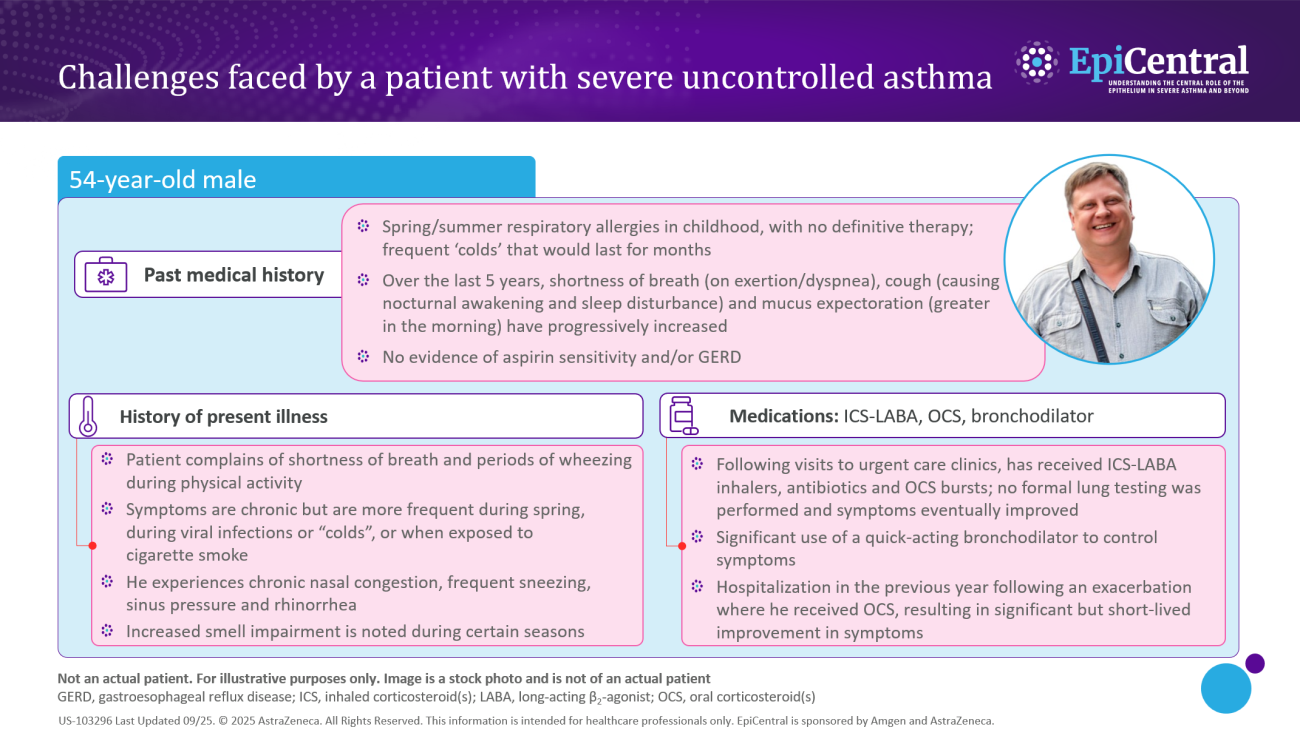
Below is an example of a patient with severe uncontrolled asthma and comorbid upper airways disease. Despite adherence to daily ICS-LABA treatment, he continues to experience symptoms that hinder his quality of life. Furthermore, the upper airway symptoms that the patient experiences are only partially improved with treatment. Co-occurrence of upper and lower airway disease is frequent,12-14 and the treatment and control of these comorbidities is essential to achieve asthma control in some patients.13

To learn more about the link between upper and lower airway disease, please click here.

Image
Case Study

Challenges faced by a patient with severe uncontrolled asthma and comorbid upper airways disease

Download resource

Suboptimal asthma control can have a significant impact on patient outcomes:

  • Exacerbations potentially leading to hospitalization occur in 12–27% of patients with severe asthma per year15-17
  • – In a US retrospective cohort study of medical and pharmacy claims databases (n=496,750), 41% of patients with severe persistent asthma had exacerbations; 14% of those had an exacerbation-related emergency department and hospital visit18

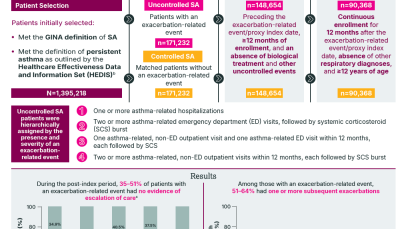
    – In a US retrospective real-world claims database study (n=171,232), 35–51% of patients who had events indicating uncontrolled disease, including exacerbations, and were hospitalized or had an emergency department or other out-patient visit, had no evidence of escalation of care11; among these patients, 51–64% had one or more subsequent exacerbation11

  • Frequent exacerbations are associated with disease severity, increased asthma-related hospital re-admissions and increased SCS exposure19-21
  • Increased airway remodeling, owing to continual damage to the epithelium,22 and leading to persistent airflow obstruction in some patients1-23
  • Increased risk of comorbidities and systemic side effects (eg, pneumonia, osteoporosis, and type 2 diabetes) associated with frequent bursts of oral corticosteroids (OCS)24,25
  • Poor quality of life (eg, activity limitation)26
  • Increased risk of mortality27

Beyond its impact on patients, suboptimal asthma control has wider implications:

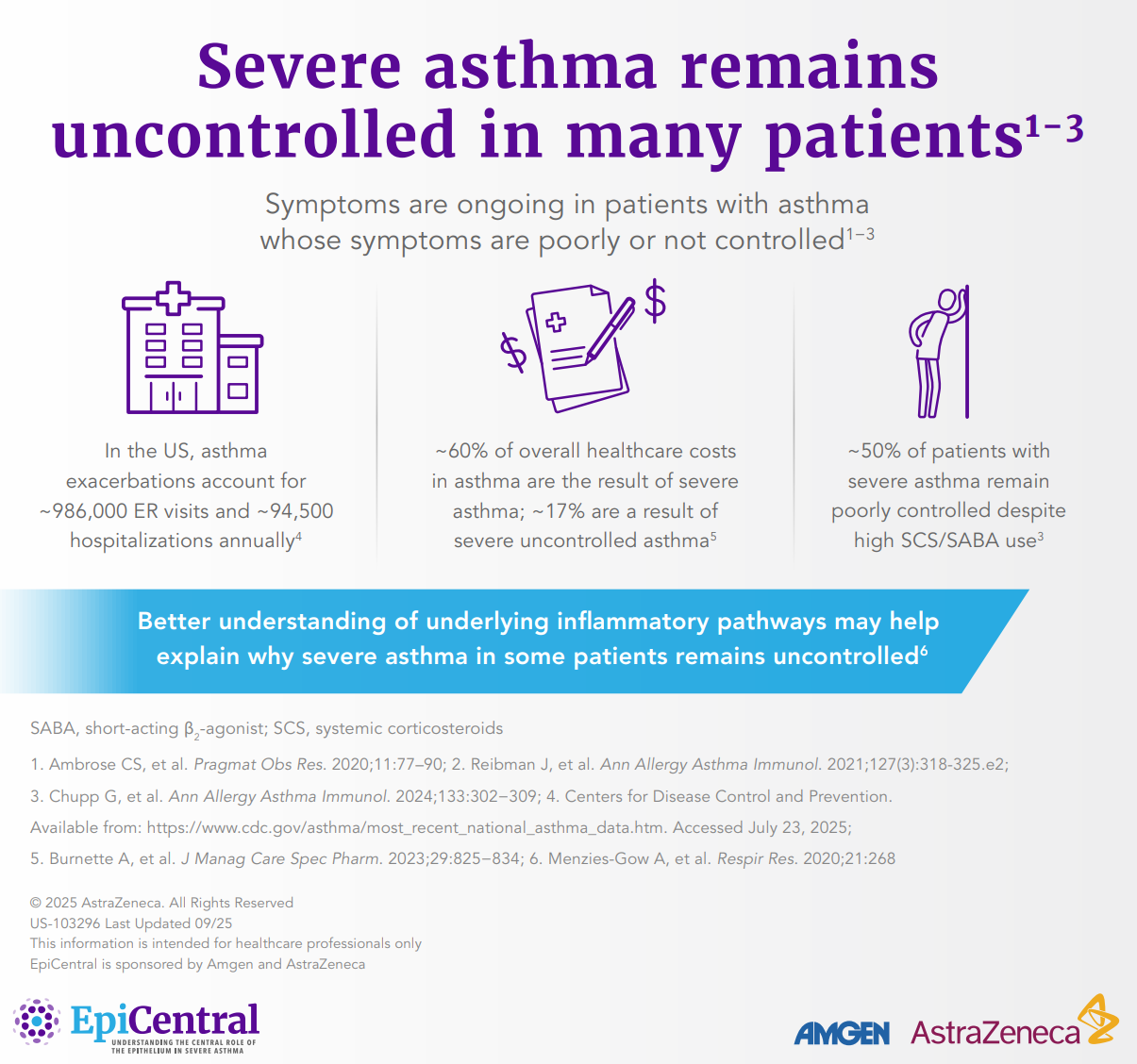
  • In the USA, healthcare costs for patients with severe uncontrolled asthma are significantly higher (up to 147%) compared with costs for patients with severe controlled disease11,28
  • Absenteeism is represented by an average of 13 working days lost when a hospital admission occurred due to an asthma exacerbation, while 5.6 days are lost on average when an asthma exacerbation is treated at home13
  • The environmental impact of asthma treatment resulting from an overuse of inhalers and increased hospitalizations following asthma exacerbations29

Image
Challenges Infographic

Overview of challenges in symptom control for patients with severe asthma

Download resource

Challenges associated with existing treatments for poorly controlled asthma

OCS are the primary therapy for resolution of acute exacerbations.30 However, patients with severe asthma are often exposed to multiple courses of OCS,31 and cumulative and chronic exposure is associated with an increased risk of side effects.25,32–34 As little as 0.5–1 g (or four lifetime courses) of OCS can cause serious adverse effects, including cataracts, pneumonia, type 2 diabetes, cardiovascular disease, renal impairment, and osteoporosis.25

In the USA, real-world evidence studies estimate that 8–30% of patients with severe asthma have received long-term or frequent short-term courses of OCS.15,35–38 A recent study found that approximately 30% of patients with severe asthma and a high exposure to OCS did not receive biologic treatment, despite continuing to experience exacerbations. 39

The annualized cost of OCS-related adverse events in patients with severe asthma on low-, medium-, and high-dose OCS is estimated to be $2712, $4724, and $8560, respectively.40

Video: Watch Professor Andrew Menzies-Gow discuss the risks of adverse events associated with​ OCS use for patients with severe asthma (00:54)

At the time of filming, Professor Andrew Menzies-Gow was affiliated with the Royal Brompton Hospital, UK; he is now an employee of AstraZeneca.

Limited access to currently available treatments is another important challenge in the management of severe asthma.41 Contributing factors include high costs and suboptimal referrals to specialized care. This is particularly relevant to the access of biological therapies for patients with severe uncontrolled asthma, where a specialist with expertise in the management of severe asthma can help assess phenotypes, identify comorbidities, and identify eligible patients.1,41,42

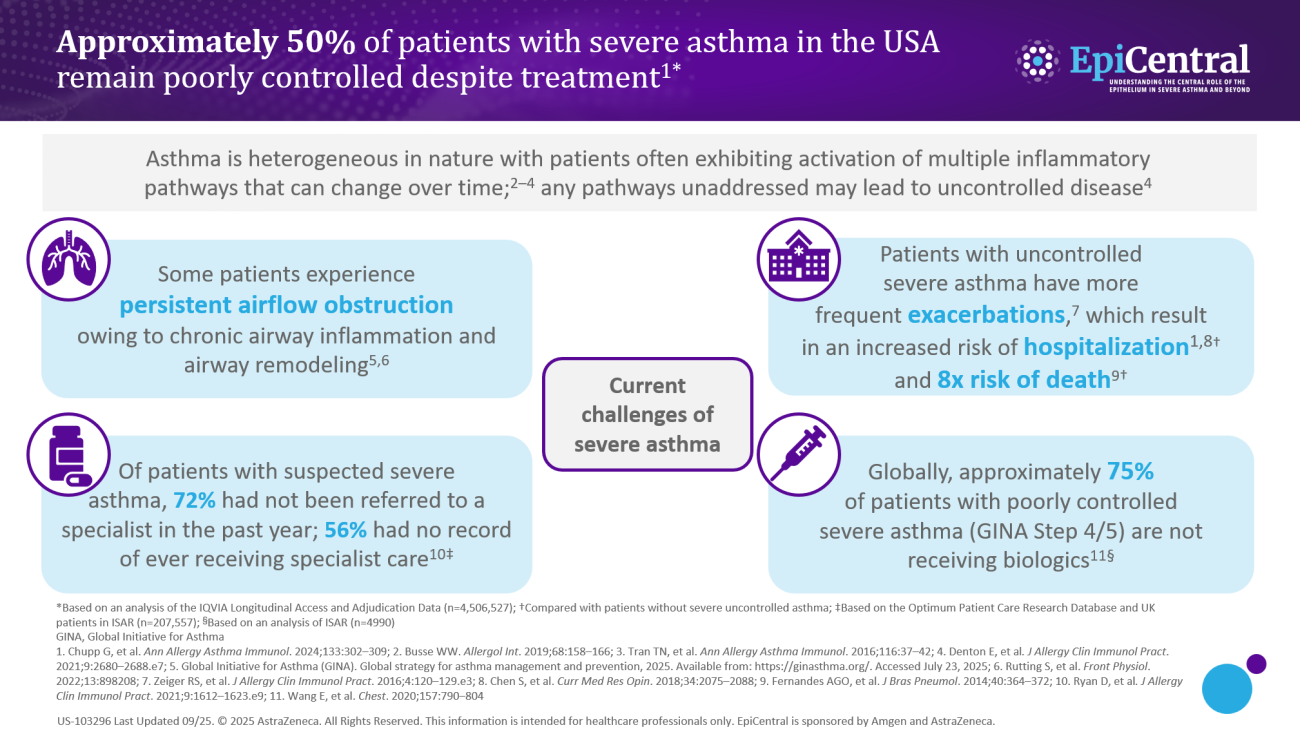
  • A study of patients from ISAR and the Optimum Patient Care Research Database (OPCRD), found that 72% of those with suspected severe asthma had not been referred to a specialist in the past year, and 56% had no record of ever receiving specialist care43
  • Similarly, in a separate analysis of ISAR (n=4990), approximately 75% of patients with poorly controlled severe asthma (GINA step 4/5) were not receiving biologics15

Asthma is heterogeneous; patients often show activation of multiple innate and adaptive inflammatory pathways.44,45 This contributes to a significant challenge in the management of severe uncontrolled asthma.1 Targeting immune-inflammatory pathways through the use of appropriate biologic therapies may offer the potential of achieving disease control in patients with different and overlapping inflammatory phenotypes.41 Furthermore, patients with asthma often experience comorbidities,12–14 and the treatment of these is essential to achieve asthma control.13

To learn more about the heterogeneity of severe asthma, please click here.

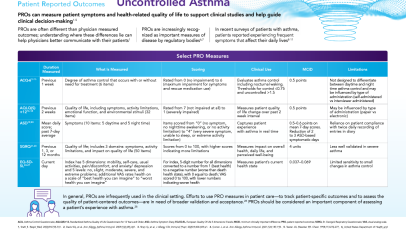
Improved validation and utilization of patient-reported outcome measures in clinical practice may further aid the diagnosis and management of patients with severe asthma and improve referral pathways.46 To learn more about patient-reported outcomes in severe asthma, click here.

Image
Challenges of Severe Asthma

Summary of current challenges in the diagnosis and management of severe asthma

Download resource

Find out more about the EpiCreator – Professor Louis-Philippe Boulet.

RELATED RESOURCES

Like this page? We have a host of other resources available in the ‘Scientific and Resource Library’ where you can find out more.

References

1. Global Initiative for Asthma (GINA). Global strategy for asthma management and prevention. 2025. Accessed January 2026.  https://ginasthma.org/; 2. Centers for Disease Control and Prevention (CDC). Most recent national asthma data. Accessed January, 2026. https://www.cdc.gov/asthma/most_recent_national_asthma_data.htm; 3. Brightling CE, et al. Ann Allergy Asthma Immunol. 2024;133:310–317.e4; 4. Thomas D, et al. Eur Respir J. 2022;60:2102583; 5. Menzies-Gow A, et al. J Allergy Clin Immunol. 2020;145:757–765; 6. Canonica GW, et al. J Allergy Clin Immunol Pract. 2023;11:3629–3637; 7. Charriot J, et al. Eur Respir Rev. 2016;25:77–92; 8. Zervas E, et al. ERJ Open Res. 2018;4:00125–2017; 9. Djukanovic R, et al. Eur Respir J. 2018;52:1801671; 10. Chupp G, et al. Ann Allergy Asthma Immunol. 2024;133:302–309; 11. Carr T, et al. J Allergy Clin Immunol Pract. 2024;12:1775–1782.e2; 12. Chen S, et al. Curr Med Res Opin. 2020;36:1897–1911; 13. Nunes C, et al. Asthma Res Pract. 2017;3:1; 14. Nissen F, et al. Br J Gen Pract. 2018;68:e775–e782; 15. Wang E, et al. Chest. 2020;157:790–804; 16. Soong W, et al. Ann Allergy Asthma Immunol. 2020;125(5 Suppl):S27 (Abstract P203); 17. Ambrose CS, et al. Pragmat Obs Res. 2020;11:77–90; 18. Camargo CA Jr, et al. Ann Allergy Asthma Immunol. 2024;132:602–609.e4; 19. Suruki RY, et al. BMC Pulm Med. 2017;17:74; 20. Halner A, et al. PLoS One. 2021;16:e0254425; 21. Jackson DJ, et al. Thorax. 2021;76:220–227; 22. Hellings PW, Steelant B. J Allergy Clin Immunol. 2020;145:1499–1509; 23. Rutting S, et al. Front Physiol. 2022;13:898208; 24. Pavord ID. Curr Opin Pulm Med. 2019;25:51–58; 25. Price DB, et al. J Asthma Allergy. 2018;11:193–204; 26. Chen H, et al. J Allergy Clin Immunol. 2007;120:396–402; 27. Busse WW, Kraft M. Eur Respir Rev. 2022;31:210176; 28. Burnette A, et al. J Manag Care Spec Pharm. 2023;29:825–834; 29. Usmani OS, Levy ML. NPJ Prim Care Respir Med. 2023;33:24; 30. Chung LP, et al. Respirology. 2020;25:161–172; 31. Papapostolou G, et al. Eur Clin Respir J. 2020;8:1856024; 32. Bleecker ER, et al. Am J Respir Crit Care Med. 2020;201:276–293; 33. Canonica GW, et al. World Allergy Organ J. 2019;12:100007; 34. Zeiger R, et al. J Allergy Clin Immunol Pract. 2020;8:3455–3465.e13; 35. Broder MS, et al. Ann Allergy Asthma Immunol. 2017;118:638–639; 36. Phipatanakul W, et al. Am J Respir Crit Care Med. 2017;195:1439–1448; 37. Wysocki K, et al. J Allergy Clin Immunol. 2014;133:915–918; 38. Zeiger RS, et al. J Allergy Clin Immunol Pract. 2017;5:1050–1060.e9; 39. Chen W, et al. J Asthma Allergy. 2022;15:1491–1510; 40. Lefebvre P, et al. Curr Med Res Opin. 2017;33:57–65; 41. Caminati M, et al. J Asthma Allergy. 2021;14:457–466; 42. Caminati M, et al. World Allergy Organ J. 2021;14:100502; 43. Ryan D, et al. J Allergy Clin Immunol Pract. 2021;9:1612–1623.e9; 44. Tran TN, et al. Ann Allergy Asthma Immunol. 2016;116:37–42; 45. Kupczyk M, et al. Allergy. 2014;69:1198–1204; 46. Herman E, et al. J Allergy Clin Immunol Pract. 2019;7:1771–1777.