Role of the epithelium in asthma

The airway epithelium has a fundamental role in airway inflammation, remodeling, and hyperresponsiveness in asthma1–3

The airway epithelium is a critical gateway for initiation and amplification of downstream pathways that drive respiratory diseases2–4

  • In a healthy state, the airway epithelium is a highly regulated structure providing an efficient physical barrier to environmental exposures.5 It also acts as an immune barrier through controlled recruitment and activation of immune cells; thus, it can be considered an immune-functioning organ6,7
  • In respiratory disease pathophysiology, the airway epithelium plays a critical role, mediating immunity via ​both the innate and adaptive responses1,2,5,6,8,9​
  • The airway epithelium is the first point of contact for environmental triggers, including pathogens, aeroallergens, and irritants1,5,6 ​
  • When inhaled triggers come into contact with the airway epithelium, epithelial cytokines thymic stromal lymphopoietin (TSLP), interleukin (IL)-33, and IL-25 are released, initiating a cascade of downstream immune responses that can lead to inflammation and structural changes and lead to the clinical features of respiratory disease6–8

Increased understanding of airway epithelial function in both healthy and disease states may contribute to better diagnostics and treatment options, which could help reduce epithelial-driven inflammation, restore epithelial health, decrease disease activity, and achieve clinical remission8,10–13

References
1. Heijink IH, et al. Clin Exp Allergy. 2014;44:620–630; 2. Hiemstra PS, et al. Eur Respir J. 2015;45:1150–1162; 3. Busse WW. Allergol Int. 2019;68:158–166; 4. Lambrecht BN, Hammad H. Nat Med. 2012;18:684–692; 5. Holgate ST. Immunol Rev. 2011;242:205–219; 6. Bartemes KR, Kita H. Clin Immunol. 2012;143:222–235; 7. Roan F, et al. J Clin Invest. 2019;129:1441–1451; 8. Gauvreau GM, et al. Expert Opin Ther Targets. 2020;24:777–792; 9. Cohen L, et al. Am J Respir Crit Care Med. 2007;176:138–145; 10. Carpaij OA, et al. Pharmacol Ther. 2019;201:8–24; 11. Russell RJ, et al. Eur Respir J. 2024;63:2301397; 12. Kaur R, Chupp G. J Allergy Clin Immunol. 2019;144:1–12; 13. Brightling CE, et al. Eur Respir Rev. 2024;33:240221.

What is the role of the airway epithelium in its healthy state and in asthma?

In a healthy state, the airway epithelium is a highly regulated structure consisting of many different cell types with a variety of functions, including acting as a physical barrier to environmental exposures from the outside world.3 As well as a physical barrier, the epithelium acts as an immune barrier to the external environment through the controlled recruitment and activation of immune cells.4,5


Video: Watch Professor Celeste Porsbjerg introduce​ the critical role of the epithelium in severe ​asthma (01:06)

The epithelium also has a fundamental role in asthma pathophysiology,2–4,6,7 as it mediates immunity via both innate and adaptive responses.4 In patients with asthma, exposure of the airway epithelium to environmental triggers results in dysregulation of the epithelium, inducing the release of epithelial-derived cytokines, or alarmins.4,5 In response to cytokine release, there is aberrant infiltration and activation of immune cells leading to chronic inflammation.4,5 In addition, some triggers may alter or damage the epithelium, promoting structural changes that can drive airway remodeling.4,6 This can trigger a vicious cycle of epithelial damage and chronic inflammation.4,6

Dr. Jonathan Corren explains the role of the airway epithelium in severe asthma here (2:17–3:00).

How do inhaled triggers interact with the epithelium?

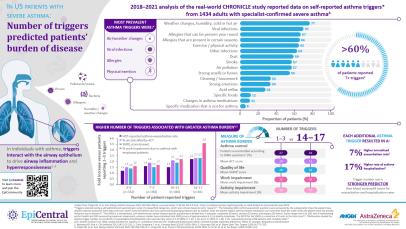
The epithelium may encounter several inhaled triggers, including pathogens (eg, respiratory viruses or bacteria),8,9 aeroallergens (eg, pollen, house dust mites, animal dander, and mold),10 and irritants (eg, cigarette smoke or air pollution, such as diesel particles).11 Triggers among patients with asthma can be diverse, and patients reporting a high burden of triggers can experience more severe asthma exacerbations than those with a low burden.12 On average, patients with severe asthma have eight different triggers that cause the release of epithelial cytokines.13

The proximity of the airway epithelium to the external environment means that it needs to respond quickly to stimuli. To enable this quick response, a range of receptors are expressed on the epithelium, including4,14:

  •  Protease-activated receptors (PARs) — these are triggered by stimuli with proteolytic activity, such as fungi and house dust mites
  • Pattern recognition receptors (PRRs) — these recognize danger- and pathogen-associated molecular patterns (DAMPs and PAMPs, respectively); both are molecules released in response to airway pathogens
    • Toll-like receptors (TLRs) — a type of PRR that interacts with microbial components of airway pathogens


Damage to the epithelium from mechanical injury or irritants, such as smoke, may also cause dysregulation of the barrier functions and downstream inflammation.4

To learn more about the burden of triggers for patients with severe asthma in the USA, click here.

Video: Watch Professor Celeste Porsbjerg ​discuss how asthma triggers interact with the airway epithelium resulting in asthma exacerbations (01:06)

How does the epithelium contribute to asthma pathology and symptoms?

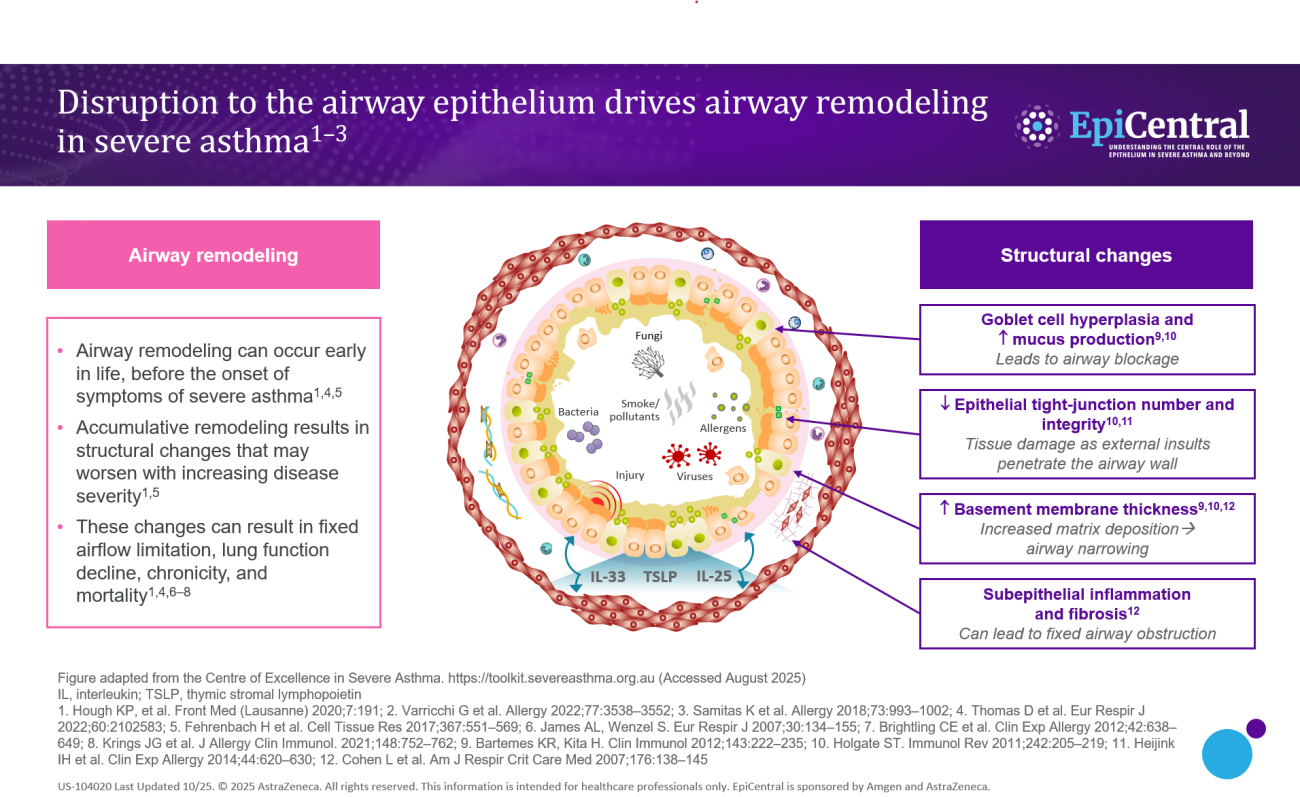
In addition to marked airway inflammation, structural changes to the airway epithelium are also observed in asthma (Figure 1), rendering the airways more vulnerable to infection and environmental triggers.4 Both the extent of inflammation and structural changes influence the severity of the disease and asthma symptomatology.3

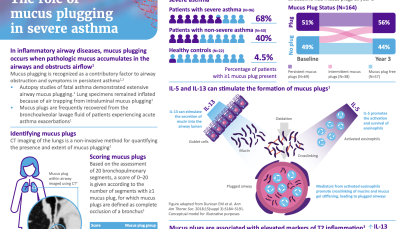
Structural changes include goblet cell hyperplasia,3,4 and, in more severe disease, a change in mucin expression, primarily an increase in the Mucin 5AC (MUC5AC) to Mucin 5B (MUC5B) ratio, resulting in an MUC5AC-rich mucus that tethers to epithelial mucus cells and markedly impairs mucociliary transport.15 This increase in submucosal goblet cells and mucus plugging can lead to airway blockage.3,15

There is also a decrease in the number and integrity of tight junctions,2,3 that may cause tissue damage as external triggers are able to penetrate the airway wall.

Increased epithelial thickness4,7 and subepithelial fibrosis7 have also been observed, resulting in airway narrowing and fixed airway obstruction, respectively.

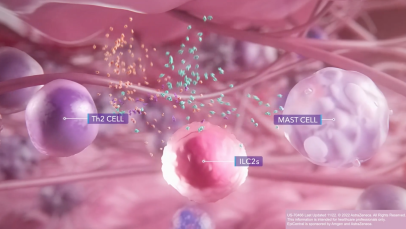
Finally, there are increased levels of inflammatory cells (including mast cells and eosinophils),16,17 which, in turn, can cause heightened inflammation and airway hyperresponsiveness.
Image
Disruption to the airway epithelium

Figure 1: Disruption to the airway epithelium drives airway remodeling in severe asthma18–20

Download resource

To learn more about the integral role of the epithelium in airway remodeling, please click here.

The mechanisms contributing to the loss of airway epithelial barrier function need to be elucidated further.16 However, it is well understood that the altered airway epithelium structure allows submucosal infiltration of inhaled triggers that interact with immune cells, causing increased inflammation and associated asthma symptoms.16

To learn more about the role of mucus plugs in asthma, please click here.

How does the epithelium mediate airway inflammation?

When inhaled triggers come into contact with the airway epithelium and specific receptors, epithelial cytokines, referred to as alarmins, are released.6 For example, inhaled microbes can activate TLRs on the epithelial surface, which 'in turn' may cause epithelial cells to produce and release TSLP, IL-33, and IL-25.4 In addition, mechanical injury to the airway epithelium may result in release of IL-33.4

Release of epithelial cytokines initiates a cascade of immune responses that result in inflammation and can contribute to the clinical features of asthma.4,6 Different triggers (eg, allergens, viruses, air pollutants), and subsequent cytokine release, may also result in unique patterns of inflammation (eg, allergic, eosinophilic, or non-eosinophilic).6 Inflammation patterns may vary over time and in different situations within an individual patient; therefore, changes in activated pathways may partly explain the heterogeneous and dynamic nature of asthma.6

Find out more about the EpiCreator – Professor Celeste Porsbjerg.

RELATED RESOURCES

Like this page? We have a host of other resources available in the ‘Scientific and Resource Library’ where you can find out more.

References 

1. Busse WW. Allergol Int. 2019;68:158–166; 2. Heijink IH, et al. Clin Exp Allergy. 2014;44:620–630; 3. Holgate ST. Immunol Rev. 2011;242:205–219; 4. Bartemes KR, Kita H. Clin Immunol. 2012;143:222–235; 5. Roan F, et al. J Clin Invest. 2019;129:1441–1451; 6. Gauvreau GM, et al. Expert Opin Ther Targets. 2020;24:777–792; 7. Cohen L, et al. Am J Respir Crit Care Med. 2007;176:138–145; 8. Wark PA, Gibson PG. Thorax. 2006;61:909–915; 9. Iikura M, et al. PLoS One. 2015;10:e0123584; 10. Baxi SN, Phipatanakul W. Adolesc Med State Art Rev. 2010;21:57–71; 11. Lambrecht BN, Hammad H. Nat Immunol. 2015;16:45–56; 12. Price D, et al. J Asthma. 2014;51:127–135; 13. Chipps BE, et al. Ann Allergy Asthma Immunol. 2023;130:784–790.e5; 14. Frey A, et al. Front Immunol. 2020;11:761; 15. Bonser LR, et al. J Clin Invest. 2016;126:2367–2371; 16. Calvén J, et al. Int J Mol Sci. 2020;21:8907; 17. Altman MC, et al. J Clin Invest. 2019;129:4979–4991; 18. Hough KP, et al. Front Med (Lausanne). 2020;7:191; 19. Varricchi G, et al. Allergy. 2022;77:3538–3552; 20. Samitas K, et al. Allergy. 2018;73:993–1002.