Airway hyperresponsiveness in severe asthma

Airway hyperresponsiveness is a cardinal feature of asthma1

  • Airway hyperresponsiveness is the heightened bronchoconstrictive response to stimuli that would produce little or no effect in healthy individuals1,2
  • Airway hyperresponsiveness is considered to be a key feature in the diagnosis, classification of severity, and management of asthma, and is associated with various asthma symptoms including wheezing, chest tightness, and bronchoconstriction1,3
  • Airway hyperresponsiveness results from an intricate interplay of airway inflammation, airway remodeling, and structural changes1,2,4; infiltration of airway smooth muscle by mast cells, and the resultant secretion of pro-inflammatory and profibrotic mediators, can play a key role in airway hyperresponsiveness5
  • Airway hyperresponsiveness is dynamic; its magnitude and presence can vary over time with disease activity, specific exposures, and with treatment. The severity of airway hyperresponsiveness is also associated with increased asthma severity1,2,6

The epithelium is an immune-functioning organ that initiates and amplifies airway inflammation and airway remodeling; therefore, it is a key orchestrator of airway hyperresponsiveness in asthma.7

References
1.
Chapman DG, Irvin CG. Clin Exp Allergy. 2015;45:706–719; 2. Comberiati P, et al. Immunol Allergy Clin North Am. 2018;38:545–571; 3. Rayees S, Din I. Asthma: pathophysiology, herbal and modern therapeutic interventions. Cham, Switzerland: Springer International Publishing. 2021; 4. Berair R, et al. J Allergy (Cairo). 2013;2013:185971; 5. Bradding P. Eur Respir J. 2007;29:827–830; 6. in’t Veen JC, et al. Am J Respir Crit Care Med. 1999;160:93–99; 7. Raby KL, et al. Front Immunol. 2023;14:1201658.

What is airway hyperresponsiveness?

Airway hyperresponsiveness is a cardinal feature of asthma.1 It is the heightened bronchoconstrictive response to stimuli that would produce little or no effect in healthy individuals.1,2

Airway hyperresponsiveness can be direct, referring to bronchial reactions to stimuli that act directly on specific airway smooth muscle receptors, or indirect, resulting from stimuli that affect intermediary pathways, which then provoke airway smooth muscle responses.3

Airway hyperresponsiveness is considered to be a key feature in the diagnosis, classification of severity, and management of asthma.1

Video: Watch Professor Bruce Levy introduce​ airway hyperresponsiveness (01:58)

What are the roles of airway inflammation, airway remodeling, and structural changes in airway hyperresponsiveness?

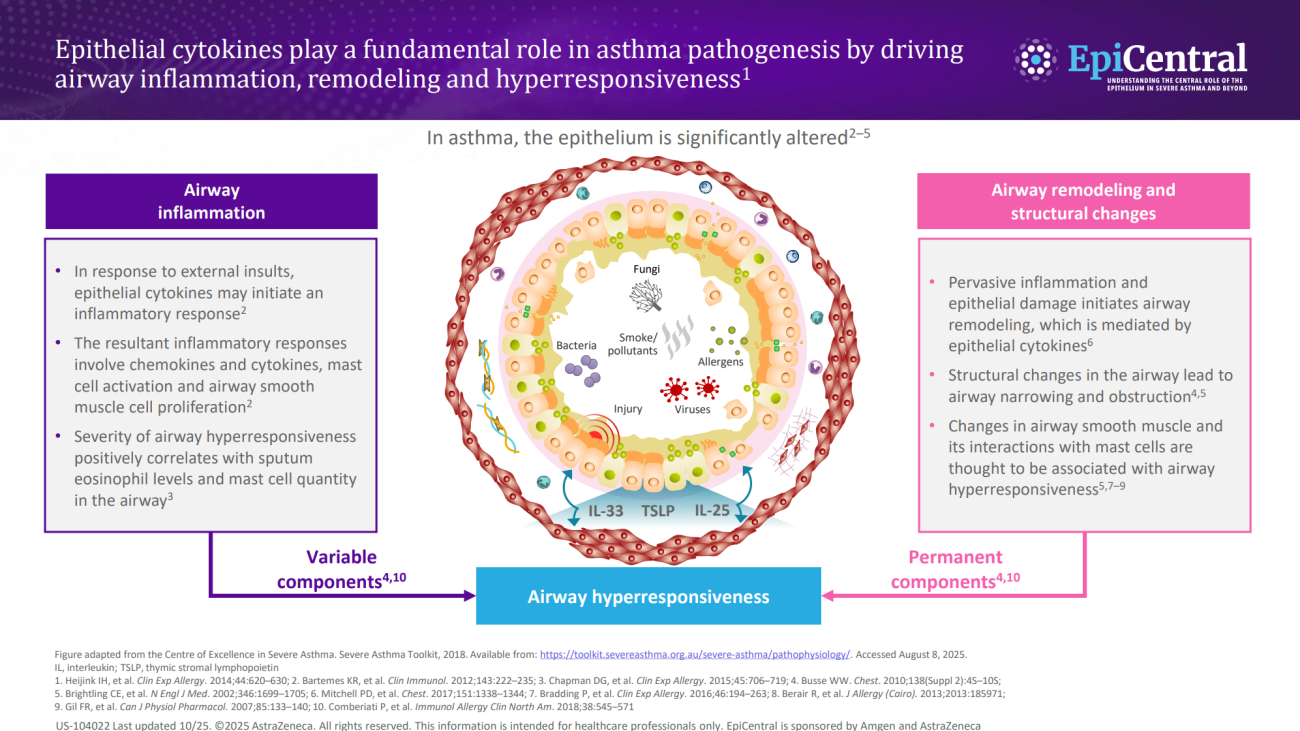
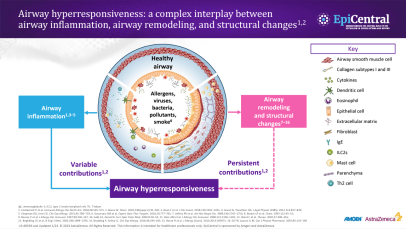
Airway hyperresponsiveness results from an intricate interplay of airway inflammation, airway remodeling, and structural changes.1,2,4

Image
US EpiCentral _AHR Module_Inflammation Remodelling and Hyperresponsiveness Hero Asset

A summary of the complex interplay between airway inflammation, airway remodeling, and structural changes in airway hyperresponsiveness.

Download resource

Airway inflammation can result in airway hyperresponsiveness through production of downstream inflammatory cytokines in the inflammatory cascade and cross-talk between mast cells and the airway smooth muscle.5,6 Epithelial cytokines, thymic stromal lymphopoietin (TSLP), interleukin (IL)-33, and IL-25, released as part of the inflammatory response, are involved in driving airway hyperresponsiveness.7

The degree and/or severity of airway inflammation contribute to the variability of airway hyperresponsiveness in patients,2,8 and airway hyperresponsiveness can also occur independently of airway inflammation.9 The severity of airway hyperresponsiveness has been associated with the number of inflammatory cells, including eosinophils and mast cells in the airway.1

To learn more about the role of airway inflammation in asthma, please click here.

In addition to airway inflammation, airway remodeling, encompassing a range of structural changes, is considered to have permanent or persistent contributions to airway hyperresponsiveness.2,8 Structural changes associated with bronchoconstriction include: epithelial damage, airway wall thickening, epithelial cell hyperplasia, subepithelial fibrosis, reticular basement membrane thickening, loss of airway tethering to parenchyma, airway smooth muscle hypertrophy and hyperplasia, and altered extracellular matrix; these are all associated with airway hyperresponsiveness.10–16 Airway remodeling and its contributions to airway hyperresponsiveness is an area of evolving research.1,17,18

To learn more about the role of airway remodeling in asthma, please click here.

In-vitro studies have shown that patients with asthma exhibit fundamental physiological changes in their airway smooth muscle.4,19 Compared with airway smooth muscle from healthy individuals, airway smooth muscle from patients with asthma displays enhanced shortening and increased contractility, which is hypothesized to involve mast cell infiltration; these changes can be another driver of airway hyperresponsiveness.4,19,20

Click here to access more information about the fundamental role of the epithelial cytokines in driving airway inflammation, airway remodeling, and structural changes resulting in airway hyperresponsiveness.

What is the role of mast cells and airway smooth muscle in airway hyperresponsiveness?

In response to external triggers, epithelial cytokines initiate an inflammatory response, activating mast cells and airway smooth muscle contraction.21,22 Infiltration of airway smooth muscle by mast cells and the resultant secretion of mediators play a key role in airway hyperresponsiveness:20

  • In patients with asthma, mast cells are recruited to the airway smooth muscle bundle by chemokines,23–25 adhering and elongating as a result.23,25,26 This change in the phenotype has been associated with heightened activation, with mast cells expressing a number of important mediators, including histamine, prostaglandin D2, tryptase, and cytokines such as TSLP, IL-33, and IL-1325,27–31
  • The smooth muscle also releases mediators including transforming growth factor (TGF)-β, amplifying the contractility32–34
  • The mass of airway smooth muscle can also increase owing to the release of mediators, which pull fibrocytes into the airway smooth muscle bundle35–37
  • These combined processes result in airway smooth muscle hypercontractility, bronchoconstriction, and an increase in smooth muscle mass27–29,32–38

The number of mast cells in the airway smooth muscle bundle correlates to the degree of airway hyperresponsiveness.25,39

In-vitro, mast cells from human lungs are in a continuously ‘activated’ state when co‑cultured with human airway smooth muscle cells, with evidence of ongoing degranulation and expression of type 2 (T2) cytokines.40 This can drive ongoing airway inflammation and airway hyperresponsiveness.40

Intraepithelial mast cells are also associated with indirect airway hyperresponsiveness; in-vitro and ex-vivo data demonstrate that there is cross-talk between mast cells and epithelial-derived TSLP and IL-33 during indirect airway hyperresponsiveness.41,42 Intraepithelial eosinophils are also associated with airway hyperresponsiveness and T2 inflammation.43

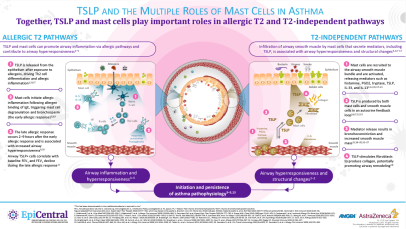
Click here for a deep dive into the role of mast cells, as well as TSLP, in airway hyperresponsiveness.

Why is airway hyperresponsiveness important clinically?

Airway hyperresponsiveness is a fundamental feature of asthma1; it is associated with various asthma symptoms including wheezing, chest tightness, and bronchoconstriction.44

Airway hyperresponsiveness is associated with a number of clinical aspects of asthma.1,45–48 Severity of airway hyperresponsiveness is associated with increased asthma severity, as measured by symptoms, lung function, and risk of exacerbations.1,45 Presence of airway hyperresponsiveness is associated with accelerated loss of lung function, airflow limitation in adults, and an increased likelihood of persistence of wheezing.2,47,48

Multiple factors affect airway hyperresponsiveness clinically, including level of treatment and exposure to environmental stimuli.49–51 Airway hyperresponsiveness is dynamic; its magnitude and presence can vary over time with disease activity, specific exposures, or treatment.2

Video: Watch Professor Gail Gauvreau discuss ​the clinical relevance of airway ​hyperresponsiveness in patients with asthma ​ (03:40)

For more information on the clinical importance of airway hyperresponsiveness, how it presents in patients with asthma, and how it is tested, please listen to Professor Chris Brightling and Professor Bruce Levy here from 06:13 min to 11:49 min.

How can airway hyperresponsiveness be measured?

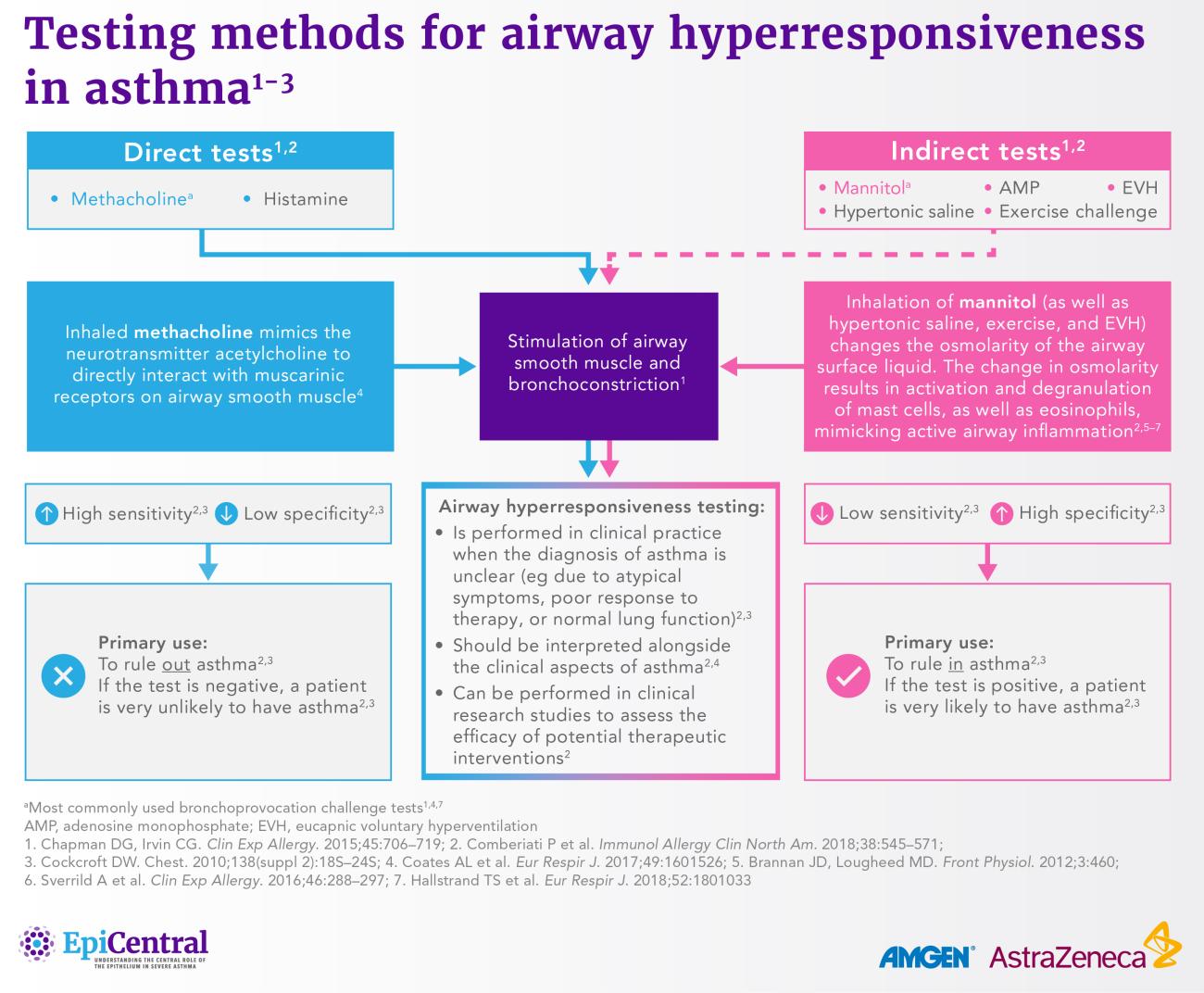
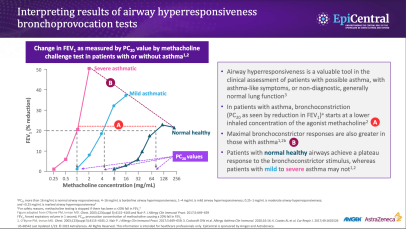
Airway hyperresponsiveness can be measured to confirm or exclude a diagnosis of asthma, classify the severity of asthma, or monitor asthma control.2,52–55 Airway hyperresponsiveness can be measured directly or indirectly and involves stimulation of airway smooth muscle with various agents.1,2,56 The two most common methods for testing airway hyperresponsiveness are methacholine, a direct challenge, and mannitol, an indirect challenge.1,2,52,57

Image
Summary of the testing methods used for airway hyperresponsiveness in asthma

Summary of the testing methods used for airway hyperresponsiveness in asthma

Download resource

Click here for a deep dive into the tests for airway hyperresponsiveness, including mechanisms of testing, interpretation of results, and contraindications.

The importance of airway hyperresponsiveness in asthma

Airway hyperresponsiveness is a cardinal feature of asthma.1 Activation of the epithelium by injury and external triggers results in an intricate interplay of airway inflammation, airway remodeling, and structural changes contributing to airway hyperresponsiveness; however, airway hyperresponsiveness can be present in the absence of significant airway inflammation.1,2,4 Understanding the mechanisms of airway hyperresponsiveness can provide greater insights into the diverse pathways that underlie asthma pathophysiology.1 Preventing or reducing damage to the epithelium may lead to a reduction in airway inflammation, remodeling, and consequently airway hyperresponsiveness.1,18,21,22

Find out more about the EpiCreator – Professor Bruce Levy and Professor Chris Brightling.

The content for this module was also created with the support of Professor Teal Hallstrand.

RELATED RESOURCES

Like this page? We have a host of other resources available in the ‘Scientific and Resource Library’ where you can find out more.

References
1. Chapman DG, Irvin CG. Clin Exp Allergy. 2015;45:706–719; 2. Comberiati P, et al. Immunol Allergy Clin North Am. 2018;38:545–571; 3. Borak J, Lefkowitz RY. Occup Med (Lond). 2016;66:95–105; 4. Berair R, et al. J Allergy (Cairo). 2013;2013:185971; 5. Allakhverdi Z, et al. J Allergy Clin Immunol. 2009;123:958–960; 6. Gunst SJ, Panettieri RA. J Appl Physiol (1985). 2012;113:837–839; 7. Porsbjerg CM, et al. Eur Respir J. 2020;56:2000260; 8. Busse WW. Chest. 2010;138(Suppl 2):4S–10S; 9. Crimi E, et al. Am J Respir Crit Care Med. 1998;157:4–9; 10. Jeffery PK, et al. Am Rev Respir Dis. 1989;140:1745–1753; 11. Boulet L-P, et al. Chest. 1997;112:45–52; 12. Booms P, et al. J Allergy Clin Immunol. 1997;99:330–337; 13. Gelb AF, Zamel N. Curr Opin Pulm Med. 2002;8:50–53; 14. Slats AM, et al. J Allergy Clin Immunol. 2008;121:1196–1202; 15. Ward C, et al. Thorax. 2002;57:309–316; 16. Heijink IH, et al. Allergy. 2020;75:1902–1917; 17. Fehrenbach H, et al. Cell Tissue Res. 2017;367:551–569; 18. Hough KP, et al. Front Med (Lausanne). 2020;7:191; 19. Gil FR, Lauzon A-M. Can J Physiol Pharmacol. 2007;85:133–140; 20. Bradding P. Eur Respir J. 2007;29:827–830; 21. Pelaia C, et al. J Clin Med. 2023;12:3371; 22. Raby KL, et al. Front Immunol. 2023;14:1201658; 23. Hollins F, et al. J Immunol. 2008;181:2772–2780; 24. John AE, et al. J Immunol. 2009;183:4682–4692; 25. Kaur D, et al. J Immunol. 2010;185:6105–6114; 26. Moiseeva EP, et al. PLoS One. 2013;8:e61579; 27. Kaur D, et al. Chest. 2012;142:76–85; 28. Suto W, et al. Int J Mol Sci. 2018;19:3036; 29. Robinson DS. J Allergy Clin Immunol. 2004;114:58–65; 30. Brightling CE, et al. N Engl J Med. 2002;346:1699–1705; 31. Kaur D, et al. Allergy. 2015;70:556–567; 32. Moir LM, et al. J Allergy Clin Immunol. 2008;121:1034–1039; 33. Woodman L, et al. J Immunol. 2008;181:5001–5007; 34. Tatler AL, et al. J Immunol. 2011;187:6094–6107; 35. Saunders R, et al. J Allergy Clin Immunol. 2009;123:376–384; 36. Saunders R, et al. Clin Transl Immunology. 2020;9:e1205; 37. Singh SR, et al. Allergy. 2014;69:1189–1197; 38. Begueret H, et al. Thorax. 2007;62:8–15; 39. Siddiqui S, et al. J Allergy Clin Immunol. 2008;122:335–341; 40. Bonvini SJ, et al. Eur Respir J. 2020;56:1901458; 41. Lai Y, et al. J Allergy Clin Immunol. 2014;133:1448–1455; 42. Altman MC, et al. J Clin Invest. 2019;129:4979–4991; 43. Al-Shaikhly T, et al. Eur Respir J. 2022;60:2101865; 44. Rayees S, Din I. Asthma: pathophysiology, herbal and modern therapeutic interventions. 1st ed. Cham, Switzerland: Springer International Publishing; 2021; 45. in‘t Veen JC, et al. Am J Respir Crit Care Med. 1999;160:93–99; 46. Leuppi JD, et al. Am J Respir Crit Care Med. 2001;163:406–412; 47. Rijcken B, Weiss ST. Am J Respir Crit Care Med. 1996;154:S246–S249; 48. Sears MR, et al. N Engl J Med. 2003;349:1414–1422; 49. Cockcroft DW, et al. Clin Allergy. 1977;7:235–243; 50. Boulet LP, et al. J Allergy Clin Immunol. 1983;71:399–406; 51. Reddel HK, et al. Eur Respir J. 2000;16:226–235; 52. Coates AL, et al. Eur Respir J. 2017;49:1601526; 53. Fowler SJ, et al. Am J Respir Crit Care Med. 2000;162:1318–1322; 54. Vandenplas O, et al. Eur Respir J. 2014;43:1573–1587; 55. Weiler JM, et al. J Allergy Clin Immunol. 2016;138:1292–1295; 56. O’Byrne PM, Inman MD. Chest. 2003;123:411S–416S; 57. Hallstrand TS, et al. Eur Respir J. 2018;52:1801033.