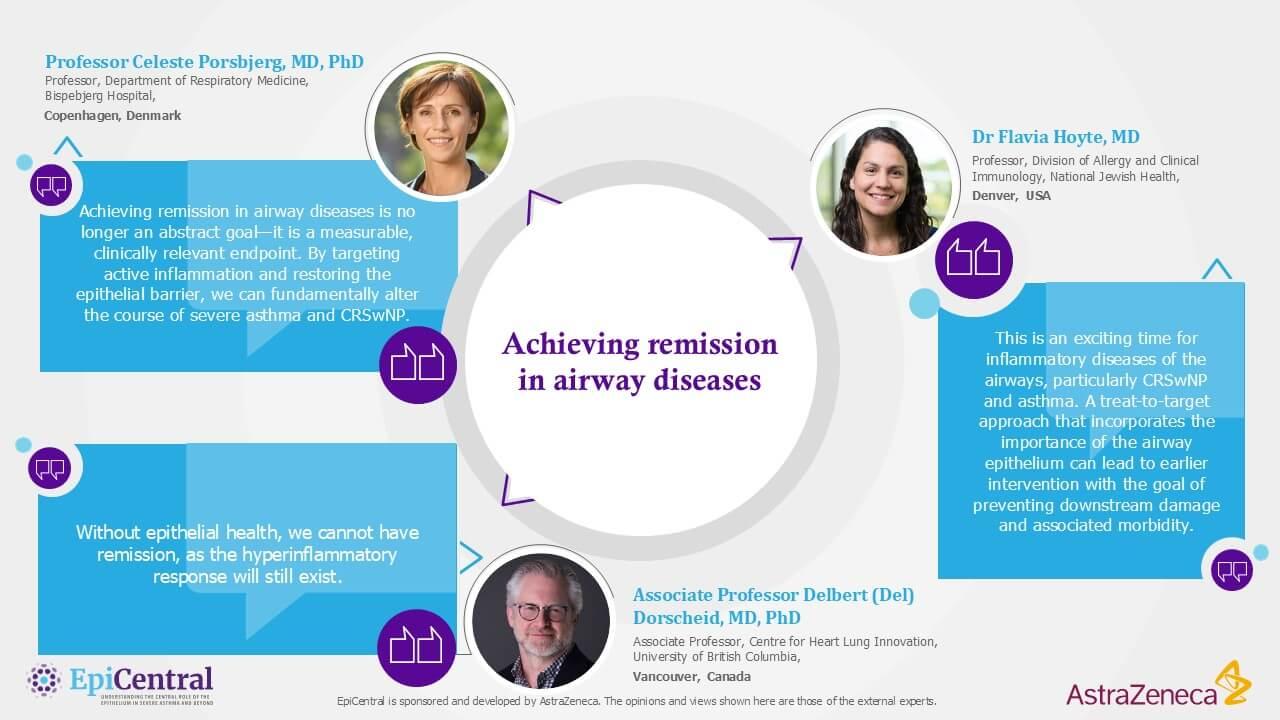
Achieving remission in airway diseases

Restoring epithelial health: can this lead to remission in patients with airway diseases?

Module synopsis

Should remission be a treatment goal in airway diseases?

  • There is a lack of consensus around the definition of remission in asthma and chronic rhinosinusitis with nasal polyps (CRSwNP), but proposed criteria include, among others, the absence of symptoms and a reduction in background medication use1–3
  • By some definitions, remission while on biologics is possible in some patients. Approximately one in five patients with severe asthma treated with biologics achieve remission after 1 year4
  • Reducing epithelial-driven inflammation and restoring epithelial health could be an important step on the road to remission5–8
  • The goal of achieving remission should be to reduce disease activity to promote repair of damaged airways1,3,7,12
  • Mechanisms of epithelial repair, including increasing tight junction expression and normalizing ciliary beat frequency, may contribute to improvements in clinical outcomes5,7,9–11,13,14

1. Caminati M, et al. Curr Allergy Asthma Rep. 2024;24(1): 11–23; 2. Carpaij OA, et al. Pharmacol Ther. 2019; 201: 8-24; 3. Chan Y, et al. J Otolaryngol Head Neck Surg. 2023; 52(1): 50; 4. Perez-de-Llano L, et al. Am J Respir Crit Care Med. 2024;210(7):869-880; 5. Russell RJ, et al. Eur Respir J. 2024;63(4): 2301397; 6. Davies DE. Proc Am Thorac Soc. 2009;6(8):678-82; 7. Brightling CE, et al. Eur Respir Rev. 2024;33(174):240221; 8. Heijink IH, et al. Allergy. 2020;75(8):1902-17; 9. Kempeneers C, et al. ERJ Open Res. 2023;9(5):00220-2023; 10. Noureddine N, et al. J Asthma Allergy. 2022;15:487-504; 11. Ghezzi M, et al. Children (Basel). 2021;8(12):1167; 12. Thomas D, et al. Eur Respir J. 2022;60(5):2102583; 13. Georas SN and Rezaee F. J Allergy Clin Immunol. 2014;134(3):509–520; 14. Tilley AE, et al. Annu Rev Physiol. 2015;77:379–406.

Image
Achieving remission in airway diseases
Expert quotes on remission
Download resource

Developing the definition of remission in respiratory disease

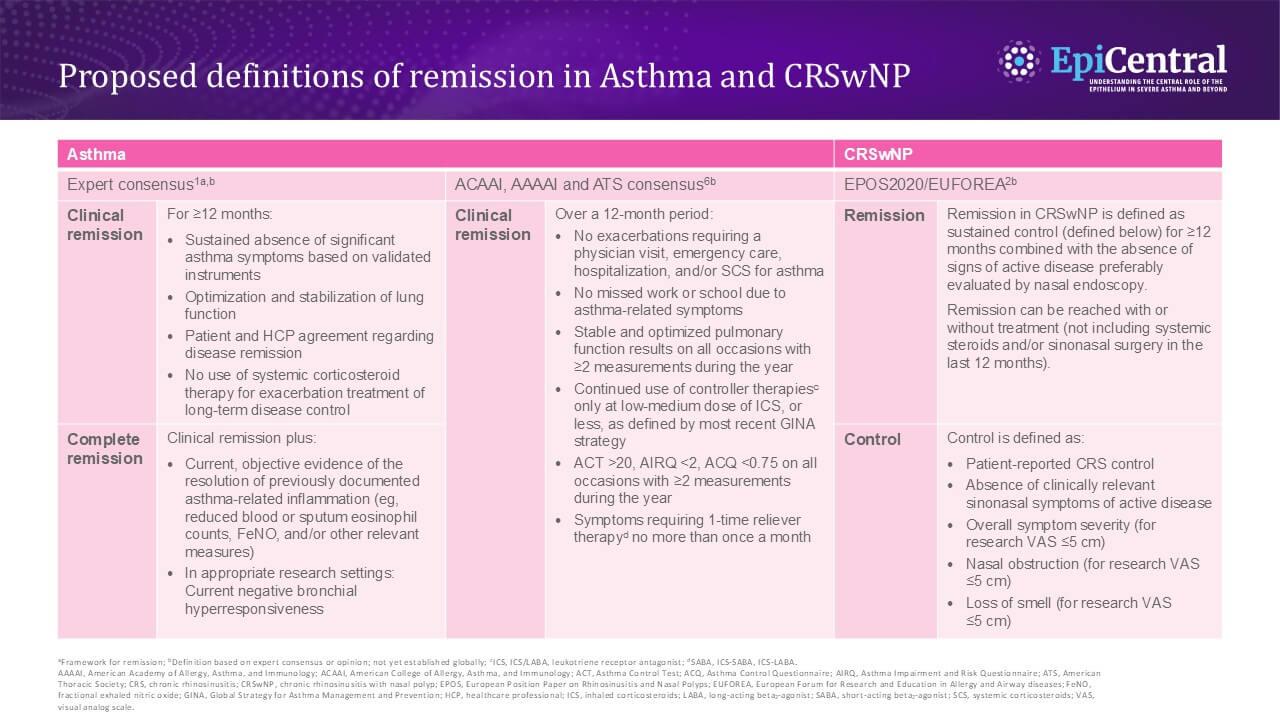
The proposed definition of clinical remission in asthma and chronic rhinosinusitis with nasal polyps (CRSwNP) has evolved over time,1,2 with a definition previously focused on spontaneous or off-treatment remission, but has now evolved to focus on remission in patients who remain on treatment.3,4 Multiple criteria for remission in airway diseases have been proposed and it remains a clinically widely debated topic.1,2,5,6 These criteria have been developed based on definitions of remission in rheumatoid arthritis, ulcerative colitis, Crohn’s disease and systemic lupus erythematosus, where remission is a recognized clinical endpoint which has supported treatment advances and improved patient outcomes.1

Broadly speaking, proposed definitions of remission in asthma include four components: no exacerbations, symptom control, no need for maintenance oral corticosteroids (OCS), and optimization and stabilization of lung function within a defined window.1,7 Similar criteria were proposed by a joint consensus of the American College of Allergy, Asthma, and Immunology, American Academy of Allergy, Asthma, and Immunology, and American Thoracic Society workgroup, but criteria for no missed work or school due to asthma-related symptoms were also included and restrictions around controller and reliever therapies were less stringent.6 In CRSwNP, remission is suggested to be defined as sustained control (patient-reported chronic rhinosinusitis (CRS) control, absence of clinically relevant sinonasal symptoms of active disease, lack of nasal obstruction, and no loss of smell) for ≥12 months.2 While remission seems to be less widely discussed in CRSwNP compared with asthma, this definition proposed by the European Forum for Research and Education in Allergy and Airway Diseases is being considered in the US and globally.8,9
Remission as a clinical endpoint in upper and lower airway diseases

Airway diseases, such as asthma and CRSwNP, are conditions characterized by chronic inflammation that cause long-term damage and potentially irreversible airway remodeling.4,10,11 Addressing the immune response and controlling disease activity to reduce inflammation is a key step to achieving remission and requires management of immune dysregulation and restoration of epithelial health.4,12-16 There has been considerable evolution in the management of airway diseases, particularly over the past 30 years, and can be used by patients to help achieve remission.10,17-21

Adopting a treat-to-target approach is currently being discussed; a treatment strategy wherein the clinician treats the patient proactively enough to reach and maintain explicitly specified and sequentially measured goals. In asthma, remission would be the treatment target, with primary goals to eliminate symptoms and exacerbation risk, prevent airway remodeling and normalize lung function.1,22,23

There is limited evidence on the rates of on-treatment remission in airway diseases based on these definitions.1,2,4,24 Following the adoption of biologics, a longitudinal cohort study has shown that one in five patients with severe asthma achieved clinical endpoint remission1 within one year of biologic initiation.21

CRSwNP studies of endoscopic sinus surgery with continued medical therapy reported remission rates of approximately 50%.24

Restoring epithelial health: evidence for epithelial repair?

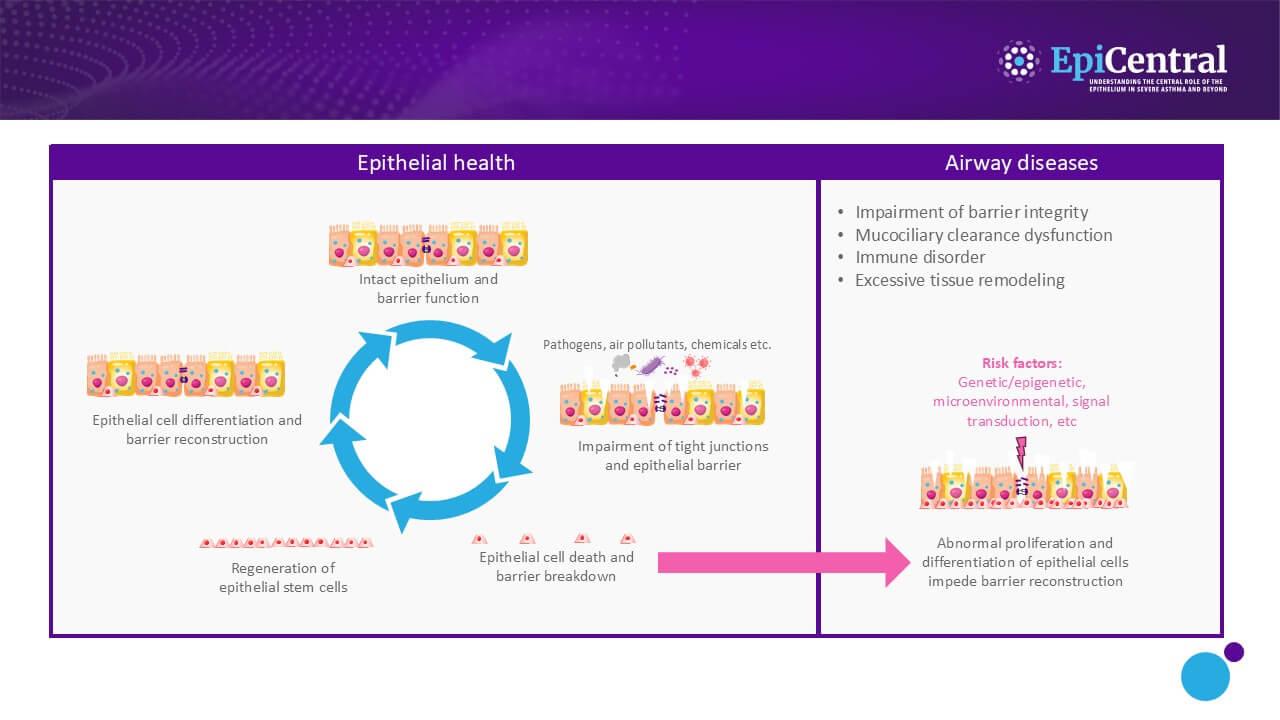
Epithelial health is dependent on many contributing factors in patients with asthma and CRSwNP. Diminishing epithelial health leads to impaired innate defense, persistent type 2 (T2) inflammation, barrier disruption and tissue remodeling.11,15,26-28

Certain studies in asthma and CRSwNP have demonstrated parallel improvements in epithelial health and clinical outcomes, but there is no definitive causal evidence to support the role of epithelial health in improving disease outcomes.29-31 Research into specific facets of barrier function (eg, mucociliary clearance) indicates that restoration of epithelial health can improve characteristics that contribute to disease pathophysiology, which may translate to improvements in clinical outcomes, but this has not been proven.32,33

In in vitro studies, barrier function was restored following treatment with epidermal growth factor, indicating that tight junction expression can be increased and that defective airway barrier function in asthma is potentially reversible.32 Repairing airway epithelial cells likely forms a key part of restoring epithelial health.15,34 There may be a need to normalize ciliary beat frequency and reduce the number of mucus-producing cells to increase mucociliary clearance and prevent the development of mucus plugs and airway occlusion.15,35,36

In patients with asthma, reversing airway remodeling, which is partially characterized by thickening of the airway epithelium, can relieve symptoms and prevent disease progression, but it is acknowledged that reversing airway remodeling is difficult.33 Corticosteroids have been shown not to sufficiently address this pathophysiology.37 Reducing epithelial-mesenchymal transition, as triggered by epithelial injury, may be a mechanism to decrease airway remodeling.28,38,39

Improvements in clinical outcomes may be consequences of epithelial restoration and reduced epithelial barrier dysfunction.1,2,37,40,41 Restoring barrier function can reduce inflammation, a driver of many symptoms in asthma and CRSwNP.41 T2 inflammatory markers positively correlate with symptoms in people with asthma and CRSwNP.42 In asthma, reducing chronic T2 inflammation decreases airway hyperresponsiveness (AHR), which leads to fewer exacerbations.15,43 Patients with lower inflammatory marker expression also have fewer symptoms, which supports the idea that epithelial damage is associated with increased symptom burden, including reduced lung function in asthma and loss of smell, nasal obstruction, and nasal discharge in CRSwNP.10,44

In asthma, AHR and airway remodeling are consequences of damage and activation of the epithelium that leads to inflammatory signaling; preventing, reducing, or repairing this damage could improve symptoms.10,15 Epithelial barrier damage and dysfunction are drivers of the pathophysiology of asthma and CRSwNP, and restoration of epithelial structure and function may have the downstream effect of helping patients achieve the proposed criteria of remission.1,2,10,15

Disease activity and damage – a dual approach to clinical remission

In previous discussions of remission, the ‘type’ of remission has not been consistent, nor has the underlying active disease manifestation always been considered.4,21 A dual approach to remission is now being considered, taking into account disease activity and damage.15,22,45-47 Disease activity describes the exaggerated response of the immune system triggered by the epithelium.15,48,49 Long-term damage includes remodeling and impaired epithelial cell function, and can lead to loss of lung function, development and worsening of comorbidities, and mortality.11,15,50,51

Reducing epithelial inflammation, through targeting inflammatory mediators before asthma severity escalates, could provide an opportunity to prevent epithelial damage and achieve remission.15,21,22,37 Early intervention may prevent the accumulation of irreversible damage and halt disease progression, making remission more likely.4,21,22,37 Controlling disease activity through reducing inflammation can improve patients’ chance of remission, particularly in the case of reducing the progression of airway remodeling.4,22,24,26

Remission can have a positive impact on patient outcomes and could be a clinical goal in some patients with severe asthma and CRSwNP.4,22 By definition, remission includes improved quality of life through improved symptoms, fewer exacerbations, a reduced need for OCS and improved lung function.1,4,5 All of these outcomes are associated with reduced healthcare resource utilization.1,52,53

Next steps to achieving remission

The epithelium is a key driver of inflammatory pathways and, therefore, is an important target in treating airway diseases.10,11,15 Remission in airway diseases is a viable target. In one cohort study, clinical remission was achieved in ~20% of patients with asthma on biologics. While some clinical trials have reported rates that are even higher, these rates vary between trials as a result of varying criteria of remission.21,51 The same cohort study suggested benefits of earlier intervention as chances of remission increased with shorter durations of asthma.21

A pooled analysis of patients with severe asthma treated with biologics reported that 38% and 30% of patients reached clinical remission in studies where a three-component and four-component definition of remission was implemented, respectively. Across the studies included in the meta-analysis, the rates of remission ranged greatly, from 18% to 69%. Barriers to remission identified in the analysis were comorbidities (eg, depression, obesity, chronic obstructive pulmonary disease, obstructive sleep apnea, and osteoporosis), worse lung function and symptoms, longer disease duration, and maintenance OCS use.54

Further research into remission in patients with airway diseases is needed, including:

  • What factors outside of asthma duration improve a patient’s chance of achieving remission?
  • What factors increase the risk of severe asthma and can help identify which patients require early intervention?
  • Can we identify better biomarkers for upper and lower airway diseases that normalize in patients who achieve remission?
  • Is airway remodeling reversible in patients with asthma, and is this reversal required in some patients to induce remission?
  • How can the rates of remission be increased in patients with airway diseases?

Barrier dysfunction: Histological changes and functional abnormalities of the epithelial barrier resulting from repeated injury, repair, and regeneration of the epithelium.55

Disease activity: Underlying manifestations of disease, as determined by symptoms, exacerbation frequency and response to treatment.45,56

Epithelial health: Descriptor of epithelial integrity and function; can be altered by damage or repair to the epithelium.26,57

Epithelial repair: Restoration of a damaged epithelium through interactions between immune cells and the epithelium to maintain epithelial integrity.58

Remission: A state or period with low to no disease activity that can be spontaneous or a result of therapy.1

RELATED RESOURCES

Like this page? We have a host of other resources available in the ‘Scientific and Resource Library’ where you can find out more.

References

1. Menzies-Gow A, et al. J Allergy Clin Immunol. 2020;145(3):757–765; 2. Fokkens WJ, et al. Rhinology. 2024;62(3):287–298; 3. Lommatzsch M. Curr Opin Pulm Med. 2024;30(3):325–329; 4. Thomas D, et al. Eur Respir J. 2022;60(5):2102583; 5. Busse WW, et al. J Allergy Clin Immunol Pract. 2024;12(4):894–903; 6. Blaiss M, et al. Ann Allergy Asthma Immunol. 2023;131(6):782–785; 7. Canonica GW, et al. J Allergy Clin Immunol Pract. 2023;11(12):3629–3637; 8. Hellings PW. Emerging Expert Definitions of Remission in CRSwNP [Symposium: Session ID SS-2]. ISIAN & IRS; 2024 April 4–6, 2024; Tokyo, Japan; 9. Hellings PW, et al. Rhinology. 2025;63(2):239–241; 10. Pelaia C, et al. J Clin Med. 2023;12(10):3371; 11. Maspero J, et al. ERJ Open Res. 2022;8(3):00576–02021; 12. Holgate ST. Allergol Int. 2008;57(1):1–10; 13. Hellings PW and Steelant B. J Allergy Clin Immunol. 2020;145(6):1499–1509; 14. Chabra R and Gupta M. Allergic and Environmentally Induced Asthma. Accessed January 2026. https://www.ncbi.nlm.nih.gov/books/NBK526018/. Treasure Island (FL): StatPearls Publishing; 2025. Updated 7 August 2023; 15. Russell RJ, et al. Eur Respir J. 2024;63(4):2301397; 16. Murphy RC, et al. J Allergy Clin Immunol Pract. 2021;9(7):2588–2597; 17. Crompton G. Prim Care Respir J. 2006;15(6):326–331; 18. Tanaka A. J Gen Fam Med. 2015;16(3):158–169; 19. Pavord ID, et al. Lancet. 1999;353(9171):2213–2214; 20. Hellings PW, et al. Allergy. 2024;79(5):1123–1133; 21. Perez-de-Llano L, et al. Am J Respir Crit Care Med. 2024;210(7):869–880; 22. Caminati M, et al. Curr Allergy Asthma Rep. 2024;24(1):11–23; 23. Nannini LJ. J Asthma. 2020;57(6):687–690; 24. Chan Y, et al. J Otolaryngol Head Neck Surg. 2023;52(1):50; 25. Huang ZQ, et al. Allergy. 2024;79(5):1146–1165; 26. Brightling CE, et al. Eur Respir Rev. 2024;33(174):240221; 27. Heijink IH, et al. Allergy. 2020;75(8):1902–1917; 28. Davies DE. Proc Am Thorac Soc. 2009;6(8):678–682; 29. Domvri K, et al. J Allergy Clin Immunol. 2025;155(2):425–435; 30. Huang ZQ, et al. Front Cell Dev Biol. 2020;8:572749; 31. Li CW, et al. Thorax. 2009;64(4):306–312; 32. Georas SN and Rezaee F. J Allergy Clin Immunol. 2014;134(3):509–520; 33. Huang Y and Qiu C. Ann Transl Med. 2022;10(18):1023; 34. López-Posadas R, et al. Front Cell Dev Biol. 2024;12:1258859; 35. Tilley AE, et al. Annu Rev Physiol. 2015;77:379–406; 36. Kempeneers C, et al. ERJ Open Res. 2023;9(5):00220-02023; 37. Varricchi G, et al. Eur Respir J. 2024;63(4):2301619; 38. Ha JG and Cho HJ. Int J Mol Sci. 2023;24(18):14229; 39. Sun Z, et al. Front Immunol. 2020;11:1598; 40. Noureddine N, et al. J Asthma Allergy. 2022;15:487–504; 41. Ghezzi M, et al. Children (Basel). 2021;8(12):1167; 42. Çolak Y, et al. Thorax. 2024;79(4):349–358; 43. Chapman DG and Irvin CG. Clin Exp Allergy. 2015;45(4):706–719; 44. AlBloushi S and Al-Ahmad M. Front Immunol. 2024;15:1285598; 45. Greenberg S, et al. J Allergy Clin Immunol. 2012;130(5):1071–1077.e10; 46. Al Ghobain MO, et al. Cureus. 2023;15(2):e35289; 47. Volbeda F, et al. Thorax. 2013;68(1):19–24; 48. Kohanski MA, et al. J Allergy Clin Immunol. 2021;148(5):1161–1164; 49. Kato A, et al. J Allergy Clin Immunol. 2022;149(5):1491–1503; 50. O'Byrne P, et al. Eur Respir J. 2019;54(1):1900491; 51. Mailhot-Larouche S, et al. Ann Allergy Asthma Immunol. 2025;134(1):31–45; 52. Wisnivesky J, et al. J Asthma. 2023;60(6):1072–1079; 53. Price D, et al. Eur Respir Rev. 2020;29(155):190151; 54. Shackleford A, et al. Lancet Respir Med. 2025;13(1):23–34; 55. Gon Y and Hashimoto S. Allergol Int. 2018;67(1):12–17; 56. Smith NMJ, et al. BMJ Open Respir Res. 2020;7(1):e000531; 57. Reynolds SD, et al. Proc Am Thorac Soc. 2012;9(2):27–37; 58. Inoue H, et al. J Clin Med. 2020;9(11):3698.